
Many cat trees are sized for a typical cat, and a Maine Coon, Ragdoll or Norwegian Forest Cat is not typical. These breeds are long, deep-chested and heavy. A big cat that launches itself at a top perch puts far more force through the frame than a slim 8 lb cat stepping up gently. That is why a tree that looks fine in the product photos starts to lean, creak or sag within weeks.
This guide teaches you how to judge any tree yourself, so you can find the best cat trees for large cats without relying on a ranked list. You will learn what to measure, which construction details matter, how to read a weight rating critically, and how to test a tree once it is in your living room.
Why most cat trees fail a big cat within months
Cat trees are sold mostly on appearance and price. Sellers photograph them with a small kitten or no cat at all, and the listing counts features: three perches, two condos, a hammock, dangling toys. Very little of that tells you whether the tree will stay upright under a cat that weighs 14 lb or more.
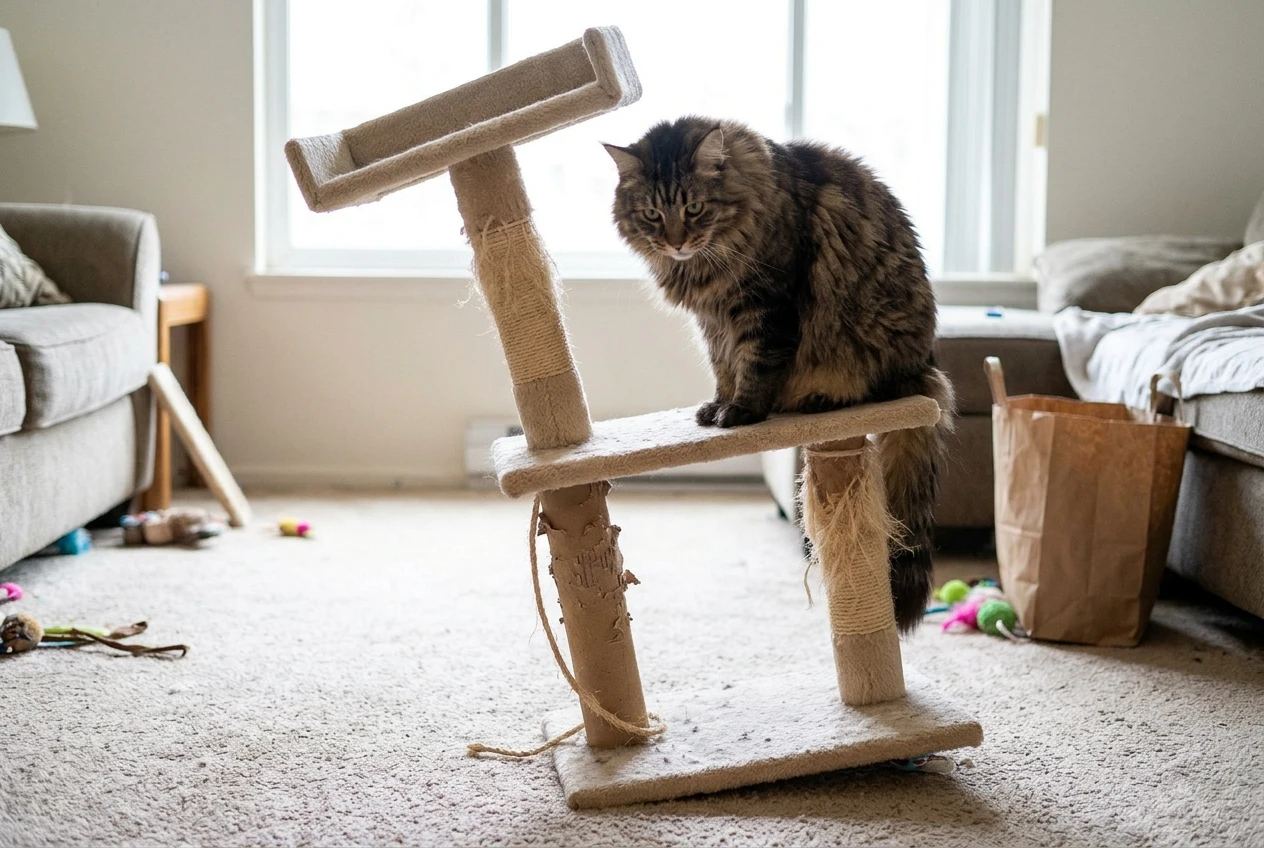
The usual failure points are predictable:
- A narrow or light base. The tree tips or rocks when the cat jumps onto the upper levels.
- Thin posts. Slim cardboard-tube or thin-wrapped posts flex, and the flex loosens every joint above them.
- Screwed-in joints in soft board. Many budget trees fasten posts to platforms with a single bolt or screw into particleboard. Each landing pulls on that fastening until the hole widens and the post wobbles.
- Small perches. A large cat cannot fit on a perch built for a small one. It hangs over the edge, shifts its weight toward one side, and levers the tree over.
- Height without width. A tall tree with a small footprint is top-heavy by design.
None of these problems is mysterious, and each one can be checked before you pay. The rest of this article is about how.
Size and weight: what a large cat really needs from a tree
Start with your own cat rather than the product page. Two measurements and one weight tell you most of what you need.
- Body length. Measure from the tip of the nose to the base of the tail while your cat is standing. A perch should be big enough for the whole body to lie on without legs and chest hanging off. As a working rule, the platform should be comfortably longer than that measurement in at least one direction, and wide enough that the cat can turn around.
- Chest and shoulder width. Measure around the widest part of the rib cage and across the shoulders. Condos, tunnels and cubbies have entrance holes, and a large cat that cannot get its shoulders through will ignore the cubby or get stuck. Compare the stated opening diameter against your cat, with some room to spare.
- Weight. Weigh your cat, or use the figure from the last vet visit. Then think about the weight that actually hits the tree. A cat that jumps lands with more force than its resting weight, and a household with two cats may have both on the tree at once.
Large breeds also tend to grow slowly. Maine Coons in particular often keep filling out for several years, so a tree bought for a young adult needs headroom for a heavier cat later. Buy for the weight your cat will be, not the weight it is today.
Height matters too, but in a different way than most shoppers expect. A very tall tree gives a big cat more to climb, yet height magnifies every weakness in the base and posts. A moderate-height tree with a wide base and thick posts is a better choice than a tall one with thin construction. If your cat wants to climb high, a floor-to-ceiling option (covered below) solves height without relying on a free-standing base.
The five stability checks: base, posts, joints, perches and top-heavy design
Run every tree through these five checks. Product descriptions and photos usually answer most of them if you know what to look for. For the rest, ask the seller or check the assembly manual, which many manufacturers post online.
1. Base
The base is what keeps the tree upright. Look for a base that is wide relative to the tree’s height, and thick and heavy rather than thin. A good base often extends beyond the footprint of the lowest perch, so the tree resists tipping in every direction.
Some trees have a lightweight base and compensate with a long wall strap. A strap is a useful backup, but a tree that needs a strap to stay upright when your cat uses it normally has a weak base.
2. Posts
Post thickness is the biggest predictor of how a tree feels under a heavy cat. Thicker posts resist bending, and they give the cat a wide surface to dig claws into. As a rule of thumb, look for posts that are noticeably thick, roughly the diameter of a large mug or wider, rather than the slim tubes common on budget models. Check what is inside the sisal or carpet wrap: solid wood or a thick, dense tube holds up better than thin cardboard.
Also check that the sisal rope is wrapped tightly and fixed at both ends. Loose wrapping unravels under the pull of a big cat’s claws.
3. Joints
This is where many trees fail. The question is how each post attaches to each platform and to the base.
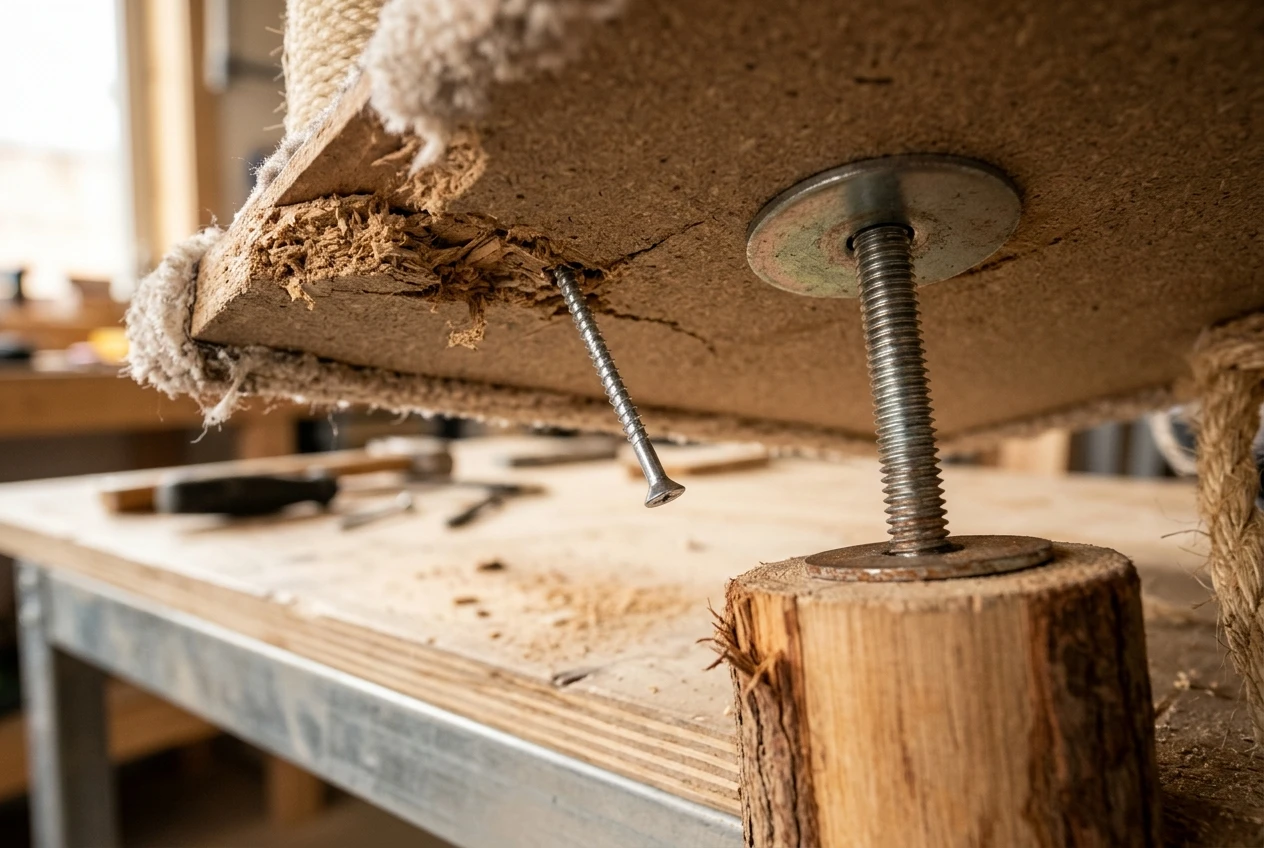
- Better: posts that thread onto a metal bolt running through the platform, or sit in a recess and are secured with a bolt, along with a solid platform material.
- Weaker: a short screw driven into the end of a post and into thin board, or posts that only press-fit into a groove.
Look at the hardware photos or the manual. Metal fittings, large washers and bolts that tighten from underneath are good signs. Staples and thin screws are not. Also check whether the assembly includes anything that stops the bolts from loosening over time, because even a good joint loosens with use and may need re-tightening every few months.
4. Perches
Check the platform size against your cat’s body length. Then check the material and thickness. Thin particleboard sags under weight and eventually cracks, while thick plywood, solid wood or reinforced board stays flat. A raised rim or bolster helps a large cat feel secure and keeps it from sliding off.
Hammocks and fabric beds need the same scrutiny. Fabric stretches, and a heavy cat in a sagging hammock is uncomfortable and puts a pulling force on the posts that hold it. Look for hammocks fixed to a rigid frame or with reinforced stitching and metal fittings. Some large cats simply prefer a flat, firm platform.
5. Top-heavy design
Look at where the weight of the tree sits. A tall tree with a big condo or large perch at the top and a small base is top-heavy. When your cat leaps onto that top level, the tree’s centre of gravity shifts and the tree rocks. A better design puts heavy elements such as the largest condo low, keeps the footprint broad, and does not stack several small bases one on another.
An offset design also matters. A perch that sticks out far to one side tips the tree toward that side when the cat lands on its edge. Balanced designs, or designs with the base extending in the direction of the overhang, are more stable.
Which tree types suit large cats: floor-to-ceiling, heavy wooden, and wide-base towers
No single type is the right answer for every home. These three tend to suit heavy cats best, for different reasons.
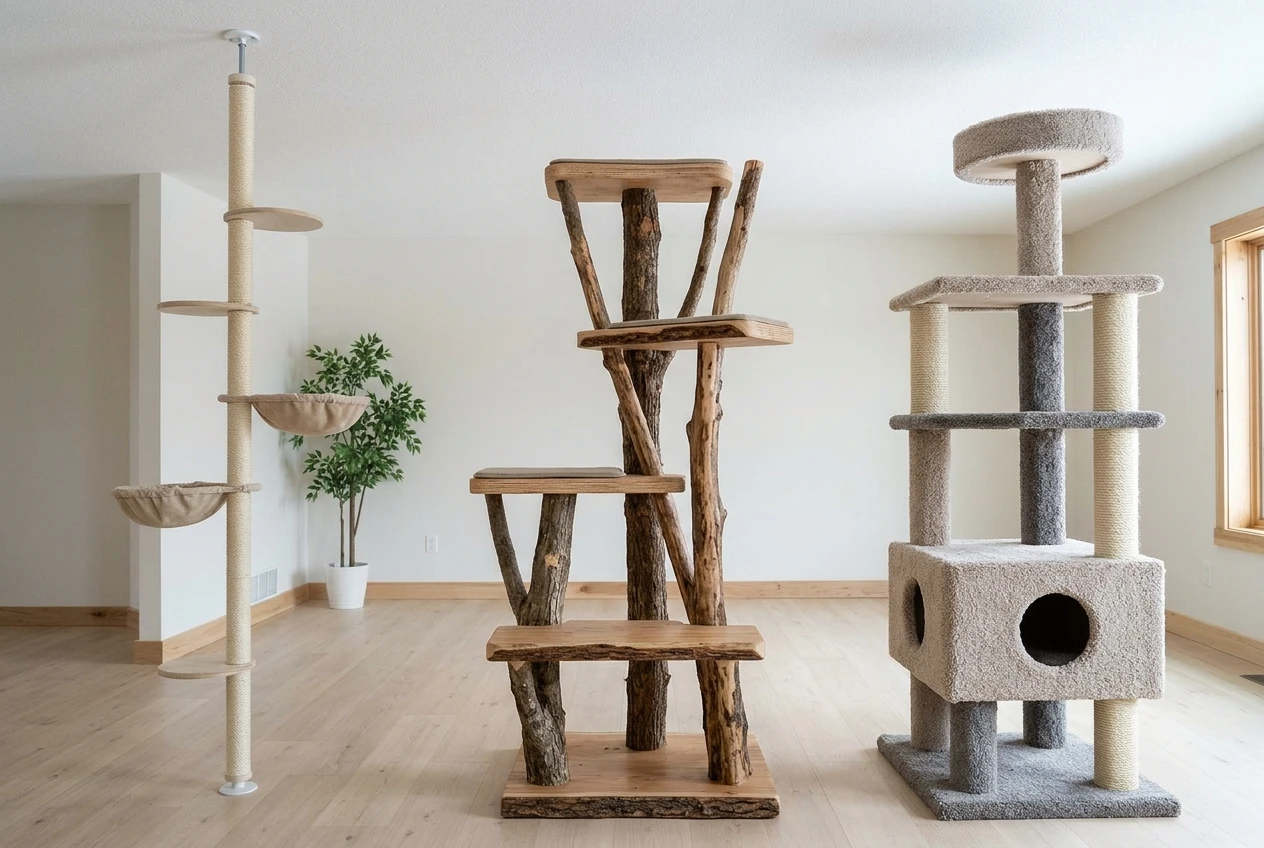
Floor-to-ceiling trees
These tension-pole trees wedge between floor and ceiling, so the ceiling does most of the work of keeping them upright. That makes them popular for tall climbing without a huge footprint. For a large cat they can be very stable, provided the following conditions are met:
- The ceiling is solid and flat. Textured or soft ceilings and suspended tile ceilings are poor choices, because the pressure plate has nothing firm to push against.
- The model’s adjustable height range covers your ceiling height with margin.
- The poles are thick and the perches are bolted, not just clamped.
- You tighten the tension properly during setup and check it from time to time.
Floor-to-ceiling trees suit a cat that climbs high and a home with limited floor space. They are a weaker match if the ceiling is unsuitable or if you cannot drill or tension anything in a rented property without worry.
Heavy wooden trees
Trees built from solid wood or thick plywood, with real fastenings, are heavier and usually more expensive. The extra mass keeps them planted, and the wood does not sag under a big cat. Many are designed more like pieces of furniture, which can suit living rooms where a bulky carpeted tower would look out of place.
The trade-offs are weight, cost and sometimes fewer play features. Check the listing for what the perches and posts are made of rather than trusting the word “wooden”, because a tree can use wood only for decoration over a board core.
Wide-base towers
These are free-standing towers with a broad, thick base and thick posts, often with a large condo at the bottom and a few big perches above. They are a good match for cats that like to climb but do not need to reach the ceiling. They are also easier to move and set up than floor-to-ceiling models, with no ceiling requirements.
For most owners of a large cat in an ordinary home, a wide-base tower with thick posts and bolted joints is the practical middle option. If your cat loves height, add a floor-to-ceiling model or a wall-mounted shelf system alongside it rather than making one tree do everything.
What to avoid, however good it looks in the photos
Some features are warning signs for a heavy cat, no matter how attractive the listing is.
- Narrow base compared with height. If the base looks small in the photos next to the upper levels, expect rocking.
- Slim posts. If the posts look thin next to a cat in the photos, they will flex under yours.
- Small round perches. Scale them against the cat in the picture, and remember the cat modelling it may be a kitten.
- Small cubby holes. A large cat may refuse to enter, or may get wedged.
- Hammocks hung from thin posts. They concentrate the load on the weakest part of the tree.
- Many levels, thin everything. Value for money looks great when a listing has seven levels, but each added level on a flimsy structure adds a place for the tree to fail.
- Assembly with only a few small screws. Check the parts photo or manual if one is available.
- No stated weight capacity at all. This does not prove the tree is weak, but it means you have nothing to verify. Ask the seller.
If the listing never shows a cat of your cat’s size on the tree, that is worth noting. Photos with a cat on the tree can still mislead if the cat is small, so use them to judge scale rather than as proof of strength.
How to read weight ratings and reviews without being fooled
A stated weight capacity looks reassuring, but it needs interpreting. Each manufacturer sets its own figure, and you cannot assume how it was determined or what it covers. Ask these questions before you rely on it:
- Is the rating per perch or for the whole tree? A total figure says little about a single platform. If the listing does not say, ask the seller or look in the manual.
- Does it describe resting weight or a jumping cat? A cat landing on a perch applies more force than a cat lying on it. Treat the rating as a minimum and choose a tree with a comfortable margin over your cat’s weight.
- Does the rating apply to the whole structure including hammocks and beds? These parts are often weaker than the platforms.
- Is the figure given by the manufacturer or only by a reseller? Compare the listing against the manufacturer’s own page, where there is one. Conflicting figures are a reason to ask questions or move on.
Because ratings are the seller’s own claim, the best way to verify one is to read the manufacturer’s documentation and, where possible, contact them directly with your cat’s weight and ask whether the tree is designed for it. A clear, specific reply is a good sign. A vague one tells you something as well.
Reading reviews
Reviews are useful when you read them for specifics.
- Search for your cat’s breed or weight. Look for reviews that mention Maine Coons, Ragdolls or similar sizes, or give a weight in pounds or kilograms.
- Favour reviews written after months of use. A tree that feels fine on day one may loosen after weeks. Reviews or follow-up comments that mention how it held up over time are worth more than first-impression reviews.
- Look at customer photos. They show real scale, real joints and real wear.
- Read the low ratings first. Check whether the complaints are about wobbling, cracking, tipping or collapsed perches. Several similar complaints from owners of big cats is a strong signal.
- Treat vague praise cautiously. “My cat loves it” says nothing about stability for a heavy animal.
Setting the tree up so your cat uses it: placement, scratching surfaces and a wobble test at home
A sturdy tree still has to be one your cat wants to use. Setup affects both safety and use.
Placement
Cats like to climb where the family is. A tree in a corner of the living room, near a window or beside where you spend time, tends to get more use than one in a spare room. A window view adds appeal, since many cats like to watch outside from a high perch.
Put the tree on a hard, level surface where possible. Thick carpet can make a free-standing tree rock because the base sinks unevenly. Keep it away from furniture the cat could use as a launch point from a distance, and away from fragile items on shelves nearby. If the tree has a wall strap, anchor it according to the manual, ideally into a stud or with suitable wall fixings.
For a general view of what an indoor cat needs from its space beyond climbing, see Basic Indoor Cat Needs.
Scratching surfaces
Large cats usually like to stretch fully while scratching, so a post tall enough for that, and sturdy enough not to move, is worth more than decorative levels. Vertical sisal is the usual favourite, and some cats also like horizontal or angled surfaces. If your cat is already scratching sofas or door frames, putting a sturdy scratching surface right beside the spot they already use makes switching easier. Our guide on how to get a cat to use a scratching post covers ways to encourage that, such as rewarding use and placing the post where the cat already scratches.
The wobble test
Do this when the tree is first assembled, and repeat it every few weeks.
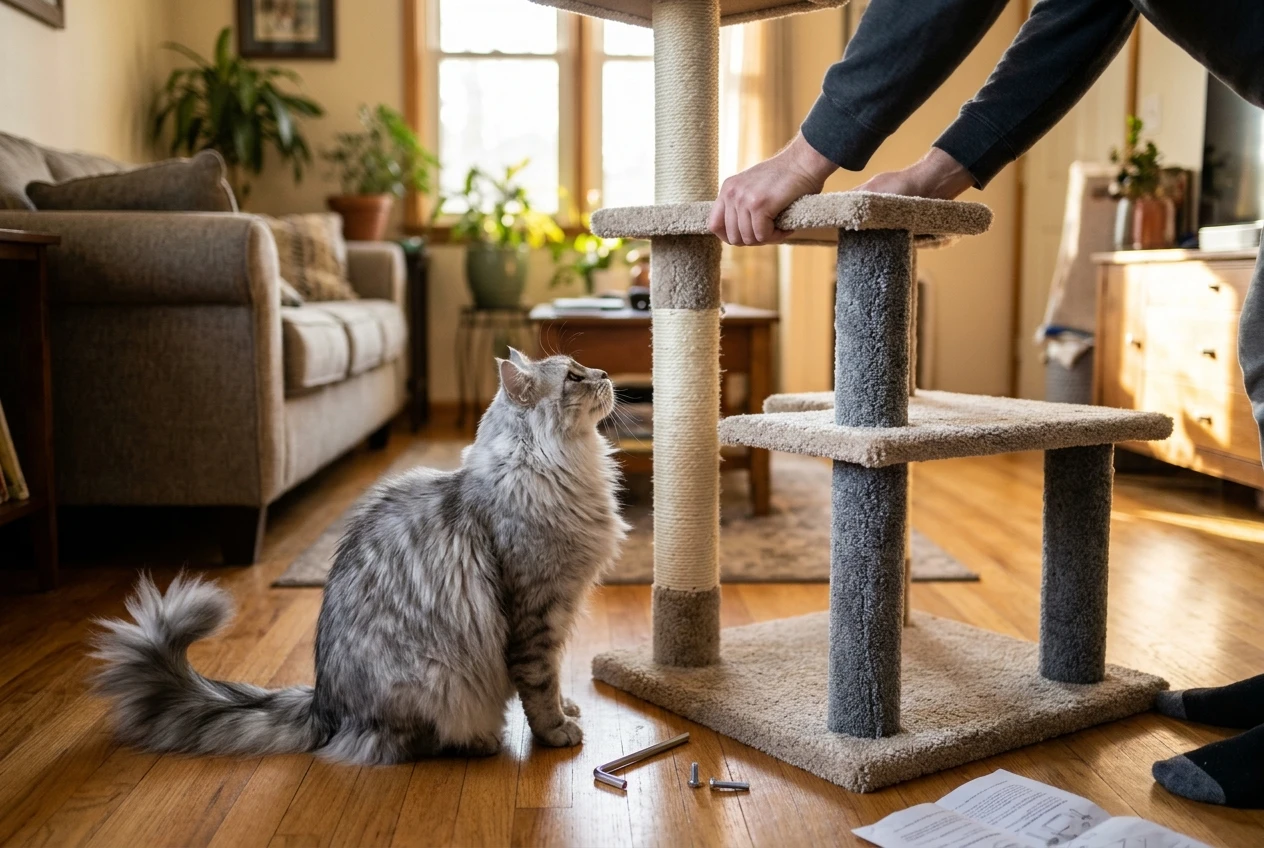
- Tighten everything. Go over every bolt and screw after assembly. Fittings usually settle after a short time, so tighten again after the first week.
- Push the top. Place your hand on the top platform and push firmly in each direction. A small amount of movement is normal. If the tree sways noticeably or the base lifts, something is wrong.
- Press down on each perch. Lean on each platform with the weight of your upper body. Listen for creaks and look for bending.
- Try a pull on the posts. Grip each post and try to twist or rock it. Any movement at the joint means a loose fitting.
- Watch your cat’s first jumps. Stay nearby when your cat first goes up. If the tree rocks on a jump, stop and fix it before the cat learns that the tree is unreliable. A cat that gets a fright from a wobbling tree may avoid it afterwards.
If a tree cannot pass this test after tightening everything, return it if you can. Retrofitting stability onto a weak design is rarely successful, although adding a wall strap or placing the base against a wall corner can help a tree that is almost stable.
Choosing for your cat: a quick shortlist checklist
Use this list to screen any tree. If a tree fails more than one or two items, keep looking.
Measure first
- Your cat’s weight, including a margin for growth if it is still maturing
- Nose-to-tail-base length, to compare against perch size
- Shoulder and chest width, to compare against entrance holes
- Your ceiling height and ceiling type, if you are considering a floor-to-ceiling model
Check the structure
- The base is wide and thick compared with the tree’s height
- The posts are thick, with dense or solid cores and tightly wrapped sisal
- Posts connect with bolts and metal fittings, not only screws into thin board
- Perches are large enough for your cat to lie flat, made of thick material, with a rim if possible
- Heavy elements sit low, and the design is not top-heavy or lopsided
- Hammocks and beds are attached securely
Check the claims
- The weight rating is stated, and you know whether it is per perch or total
- The rating gives a comfortable margin above your cat’s weight
- The manufacturer’s own page or manual confirms the figures
- Reviews from owners of cats of a similar size mention stability months later
Check the fit for your home
- There is a good place for it near where the family spends time
- The floor is level, and a wall strap can be used if needed
- You can do a wobble test as soon as it is assembled and again every few weeks
A tree that meets these points is far more likely to still be standing and in regular use a year from now. Because you have checked the construction yourself rather than trusting a headline rating, you can shortlist two or three candidates with confidence and choose the one that best suits your cat’s size and climbing habits.