
Hello, Cat Enthusiasts!
A cat left alone for a working day has the whole apartment and nothing to do in it. Outdoor cats spend their time hunting, patrolling and investigating. An indoor cat gets a bowl that is always in the same place and a window. Boredom tends to show up as night-time sprints, shredded furniture, knocked-over objects, loud demanding at the door when you return, or a cat who sleeps through the day and is wired at 3 a.m.
Buying more toys does not fix this on its own. Many cats ignore a toy that needs a human at the other end, and a pile of toys left on the floor all week stops being interesting within days. The best cat toys for solo indoor play are the ones that work without you, are safe when nobody is watching, and are used in a way that keeps them interesting.
This guide sorts toys by the hunting behaviour each one satisfies instead of ranking products. It then separates the toys you can leave out from the ones that should only come out when you are home, and ends with a simple rotation you can set up this week.
Why a bored indoor cat needs toys built for playing alone
Cats are predators with a built-in routine: watch, stalk, chase, pounce, grab and bite, then eat. Hunting satisfies that routine, and a house cat has no outlet for it unless you provide one. When the energy has nowhere to go, it goes into whatever moves or makes a satisfying noise: your ankles, curtains, a plant, the edge of the sofa.
Play with you is the best kind, because a wand toy and a person can reproduce a whole hunt. Most owners are away for hours at a stretch, though, so a cat needs things to do on its own. A toy suited to solo play has to meet a few conditions:
- It gives the cat something to do without a person moving it.
- It is safe to leave with a cat who may chew, bat and carry it around for hours.
- It satisfies a particular part of the hunt, so the cat gets something out of it each time.
Solo toys will not replace your attention. They fill the gaps while you are away, so that a cat who has been busy all day is ready for a proper play session when you walk in. If your cat’s behaviour changes suddenly, such as over-grooming, hiding, or a drop in appetite, mention it to your vet, because boredom is only one possible cause. Our piece on cat behaviours to worry about covers the signs worth taking seriously.
Match the toy to the hunting stage: stalk, chase, pounce, bite, forage
Most toy buying goes wrong because it is based on what looks appealing to the owner. A cat whose favourite part is the chase may ignore a beautiful plush toy that does not move. A cat who loves to bite and kick may have no use for a battery-powered mouse. Sorting toys by hunting stage lets you see which parts of the hunt your cat already has covered and which are missing.
Stalk: The cat watches and creeps. Tunnels, cardboard boxes with holes cut in them, paper bags with the handles removed, and anything a cat can hide behind and peek around all serve this stage. A window perch with a view of birds or street activity does the same job, though it is not a toy.
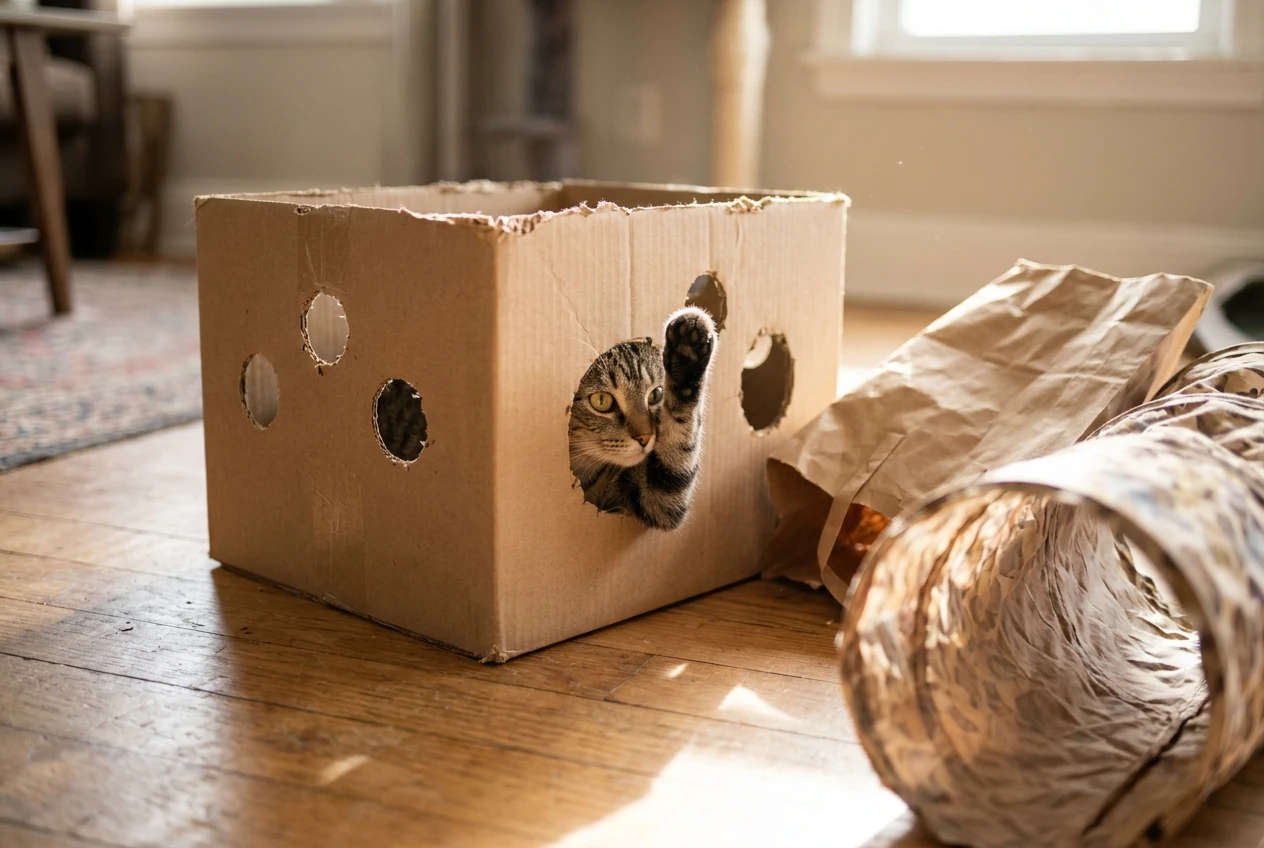
Chase: Fast, unpredictable movement triggers the sprint. Motorised mice, ball-and-track toys and rolling balls are the main solo options.
Pounce: The cat leaps and lands on the target. Anything that moves under fabric or pops out of a hole encourages this, as do toys that skitter across a hard floor and can be pinned.
Bite: The cat grabs the toy with its teeth and claws. Kicker toys, plush toys of a suitable size and sturdy chewable toys fit here.
Forage: The cat works for food. Puzzle feeders, treat balls and scatter-feeding turn a meal into a small hunt.
Most cats have a favourite stage or two. Watch which of these sequences your cat performs when you play with a wand toy at home, and note which ones it skips. A cat who stalks and pounces but never bothers with a long chase wants different solo toys from one who runs laps around the sofa. Aim to have at least one toy from several categories in your rotation, since a hunt that never reaches the catch is frustrating and the cat loses interest.
Chase toys that move without you: motorised mice, tracks and ball toys
Chase is the stage hardest to cover without a person, which is why motorised toys exist. They come in a few types, and each suits a different cat.
Motorised mice and moving toys
These toys run along the floor in short, erratic bursts. The best ones stop and start unpredictably, because a toy that moves in a steady pattern is boring quickly. Many include a tail or feathers that flick as it moves, and some switch themselves on when the cat touches them.
Before you leave one running, check three things:
- The toy has no long cord, string or tail that could wrap around a paw or neck.
- The battery compartment is secured with a screw or a firm latch, so the cat cannot open it.
- Small parts such as eyes or ears are firmly attached, because a cat who dismantles a toy can swallow what comes off.
If the toy fails any of these, keep it for supervised play. Inspect any motorised toy regularly, because they get chewed and dropped, and a toy that was safe on day one may not be after weeks of use.
Ball tracks
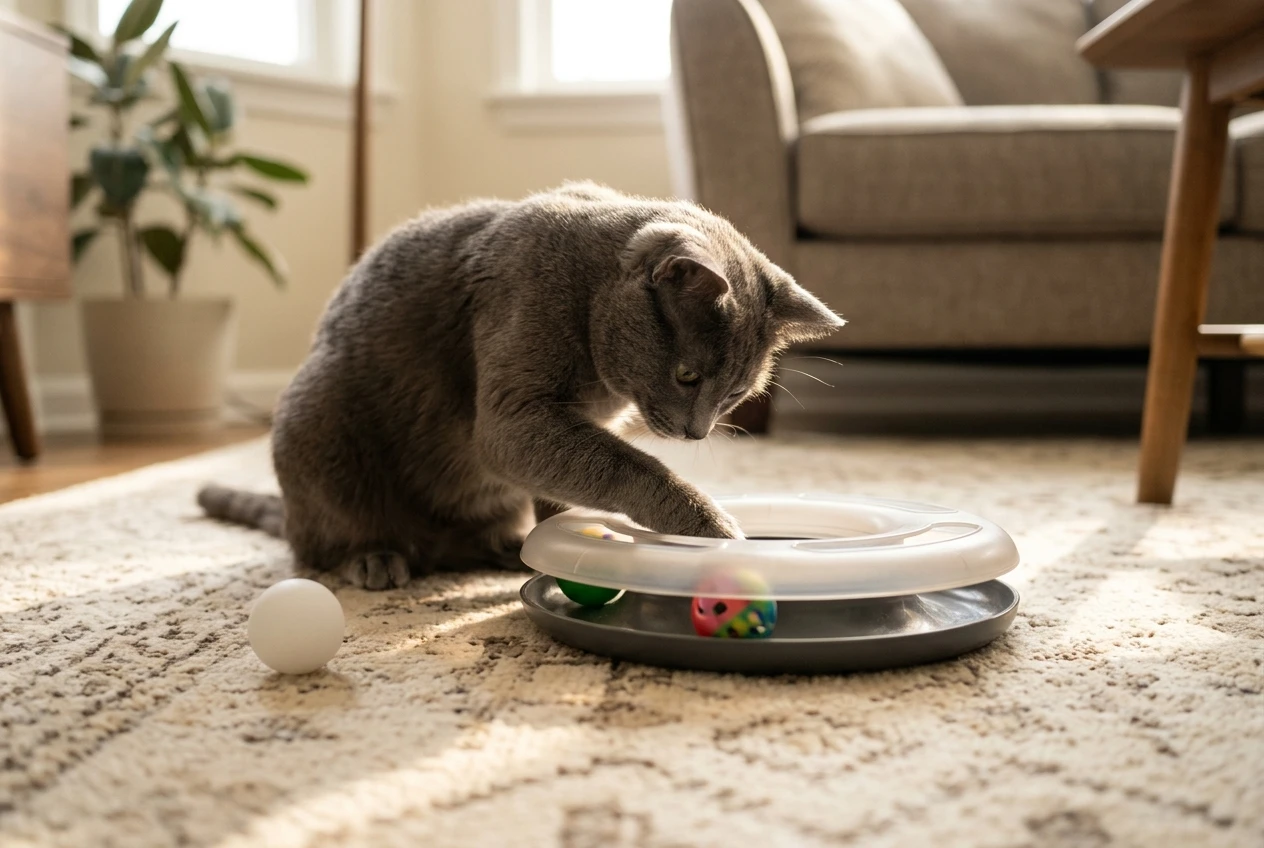
A ball-in-a-track toy is a ring or maze with a ball held inside. The cat bats the ball and it races around, so the cat can play for as long as it likes without anything going wrong. These toys are usually more reliable than motorised ones because they have no motor or battery to fail. The cat provides the movement, which makes them good for cats who like to be in control of the chase.
The ball should be too large to swallow and light enough to roll when batted. Cats who like to chew, rather than bat, may pull the ball out of the track. If yours does, a track that encloses the ball fully is the safer choice.
Loose balls
Lightweight balls, including crinkle balls, ping-pong-style balls and ones with a bell inside, work well on hard floors, where they skid and bounce. They cost very little and cats often prefer them to expensive toys. Pick balls that are too big to fit in the mouth, and replace any that start to crumble or split. A ball that rolls under the sofa is gone for the day, so a few spare ones help.
Puzzle feeders and foraging toys that turn meals into hunting
Foraging covers the last stage of the hunt, and it has an advantage over every other category: it lasts. A chase toy runs out of battery or loses its appeal in minutes, but a cat who has to work for food stays busy for as long as the food lasts.
Common types include:
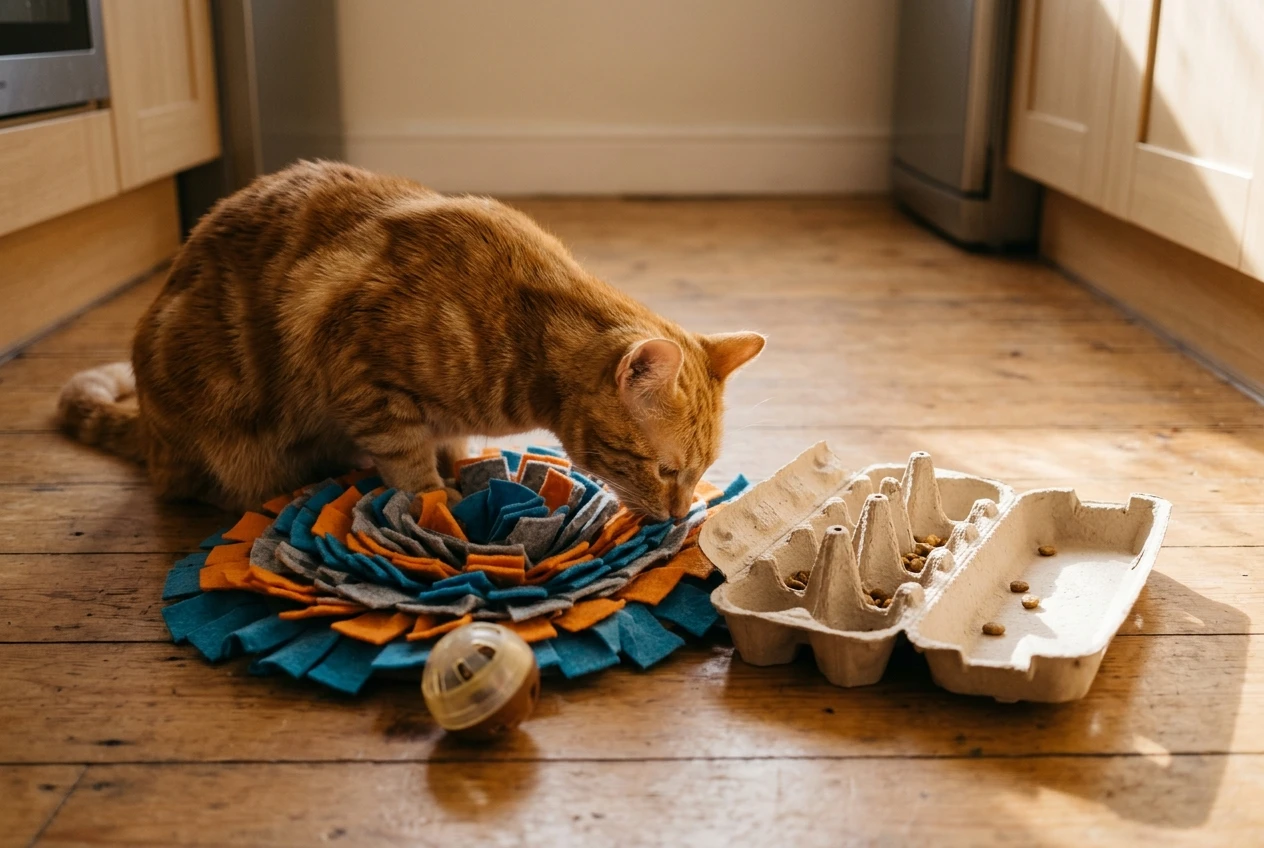
- Treat balls, which release kibble as the cat rolls them around.
- Puzzle boards, with compartments, flaps or sliding pieces that hide food.
- Snuffle mats, where kibble is tucked into fabric folds.
- Simple homemade options, such as scattering kibble around the house or putting a little in the cups of an egg carton or a cardboard tube.
Start easy. A puzzle that is too hard teaches a cat to give up, and a cat who gives up on the first one may ignore every other puzzle you buy. Begin with a feeder that gives out food freely, and make it harder only once your cat is clearly good at it.
Use part of the daily food ration in puzzles instead of adding food on top, so a busy cat does not gain weight. Dry food is the simplest to use in most feeders. If your cat eats mostly wet food, ask your vet how best to divide the day’s meals, and see whether a lick mat or a feeder designed for wet food would fit.
Foraging also fits with a feeding routine. Our piece on the importance of routines for cats explains why predictable timing matters, and a puzzle feeder left out at the same time every morning becomes part of that structure.
Kick and bite toys for cats who want something to grab and wrestle
Some cats do not want to chase or hunt for food. They want something to grab, hold between their front paws, bite and kick with their back legs. This is the end of the hunt, when the prey is caught and subdued, and a toy that cannot be caught leaves this instinct unsatisfied.
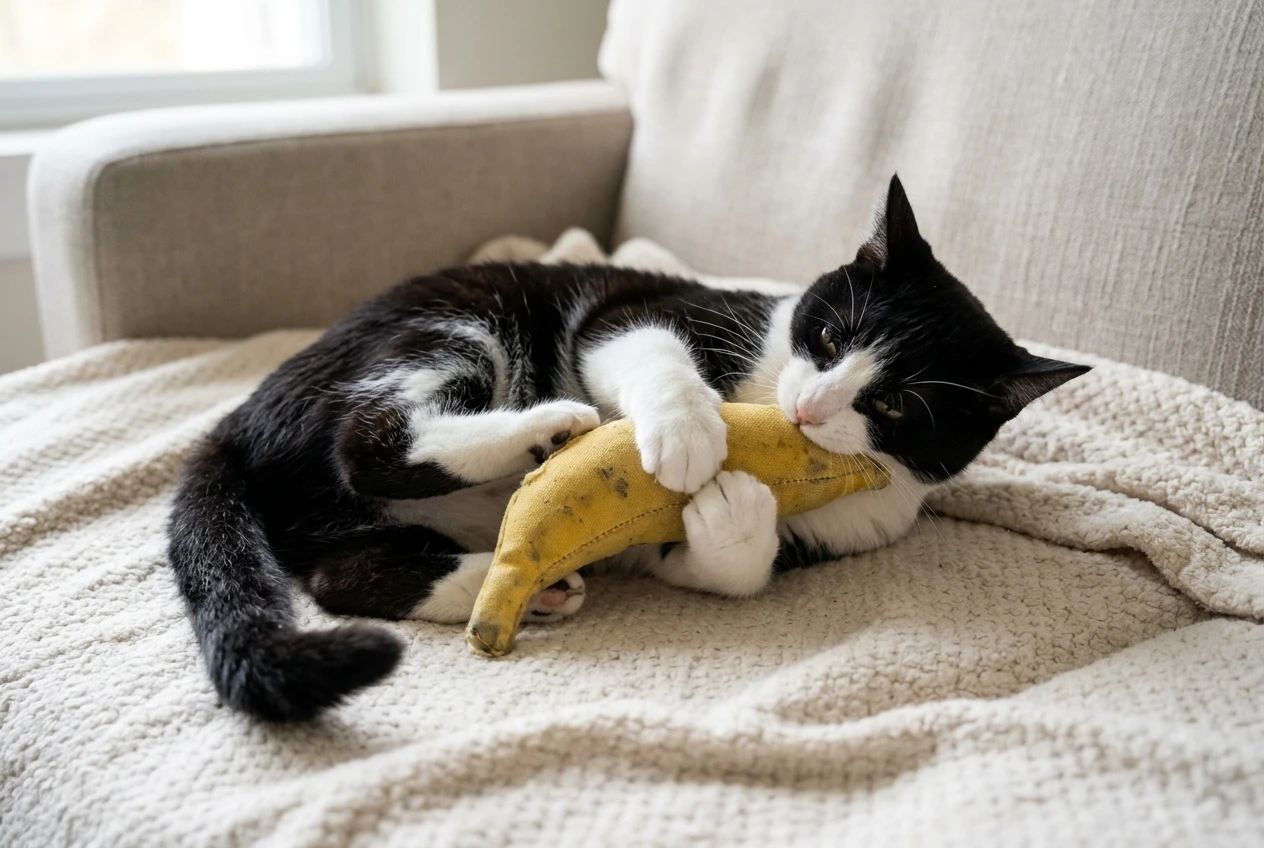
Kicker toys are long, firm, stuffed shapes, usually somewhere between the size of a banana and a small forearm. They are big enough for a cat to wrap its body around. Many are filled with catnip or silvervine, which some cats find irresistible. Not every cat responds to catnip, and kittens usually do not, so check with a small amount before assuming it will work.
When you pick a kicker or bite toy for unsupervised use, check:
- Size: big enough that it cannot be swallowed, even in pieces.
- Stitching: tight, with no loose threads that could be pulled out and eaten.
- Decoration: no buttons, plastic eyes, beads or dangling parts.
- Filling: inside a sealed, sturdy cover, so it will not spill if chewed.
Wash fabric toys occasionally, since they absorb saliva and smell. Throw away any toy that is torn or leaking stuffing. For cats who chew hard, a toy made from firm rubber or a similar material designed for cats may last longer than plush.
Scratching is a related outlet, and a cat who is shredding furniture is often expressing the same energy. A sturdy scratching post placed where the cat wants to scratch helps, and we cover that in how to stop a cat from scratching the furniture.
Toys that are never safe to leave out unsupervised: string, ribbon, wand toys
Many of the toys cats enjoy most are the ones that should only come out when you are home. Cats swallow string, thread, ribbon, yarn, tinsel and elastic bands, and a linear object that gets swallowed can cause a serious intestinal blockage that needs emergency treatment. String can also wrap around a cat’s neck, legs or tongue.
The following should be put away whenever you leave:
- Wand toys with string, feathers or ribbon. These are the best toys for interactive play and the most dangerous ones to leave lying around. Put them in a cupboard or a high drawer after each session, because a cat who finds one alone can chew the string or get tangled.
- Any toy with a long tail or dangling cord, including some motorised mice.
- Yarn, wool, ribbon, thread and dental floss, which are not toys but get treated as toys.
- Laser pointers are a supervised-only tool. They are safe from a physical point of view, but the cat can never catch the dot. Over time that frustrates some cats, so finish any laser session by directing the cat to a real toy or a treat it can catch.
- Toys with small detachable parts, such as bells, beads, glued-on eyes and plastic pieces.
- Rubber bands, hair ties and similar household items that cats are drawn to. Keep them in closed containers.
If you are not sure whether a toy is safe, test it by asking what the cat could pull off, chew through or swallow. If the answer is anything at all, treat it as a supervised toy. Our guide to household hazards for cats lists other things around the home worth checking before you leave.
Wand toys deserve a place in your routine even though they stay in the cupboard while you are out. A short session with a wand toy before you leave and another when you get home lets the cat finish a whole hunt, and a cat who has had that is more likely to settle down for the day.
How to rotate five or six toys through the week so they stay interesting
A cat gets used to anything that is always there. The same toys on the floor day after day become part of the furniture, and the cat stops noticing them. Rotation brings back the novelty without you buying anything new.
The method is simple:
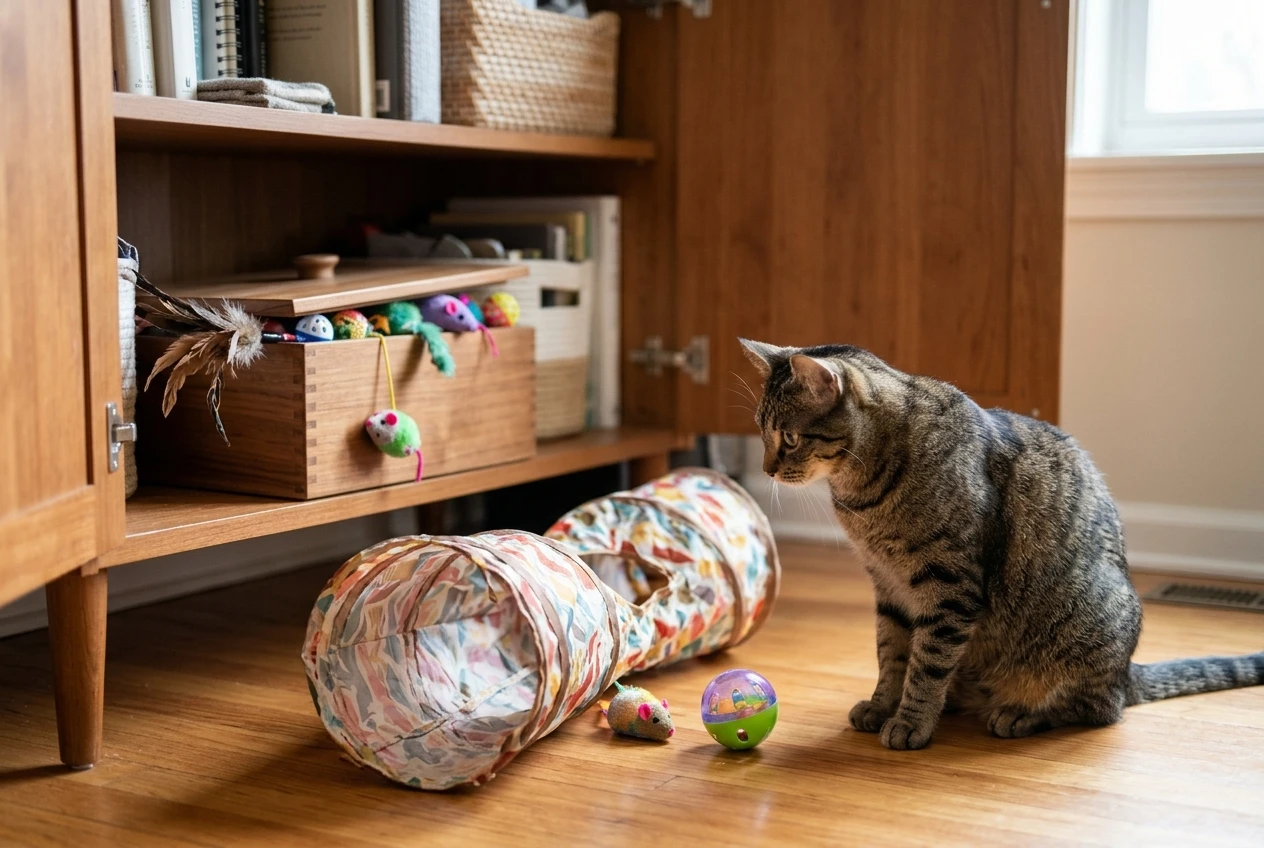
- Collect five or six solo-safe toys from at least three of the hunting categories above, such as a ball track, a kicker, a treat ball, a tunnel, a snuffle mat and a few loose balls.
- Keep most of them out of sight. A closed cupboard or box works well.
- Put out two or three each day. Make sure at least one covers foraging or chase, and one covers biting and kicking.
- Swap them out every day or two. A toy that has been away for a few days smells and feels new when it comes back.
Here is one way to lay it out over a week:
Day Out while you are away
✔️Monday Treat ball, kicker, tunnel
✔️Tuesday Ball track, snuffle mat
✔️Wednesday Loose balls, kicker, cardboard box
✔️Thursday Treat ball, ball track
✔️Friday Snuffle mat, tunnel, loose balls
✔️Saturday Kicker, cardboard box, treat ball
✔️Sunday Rest day: play with a wand toy together
This is only a template. Adjust it to what your cat likes. If your cat is obsessed with the kicker, leave it out more often, and drop anything that is consistently ignored.
Add one more habit: a foraging toy in the morning and something new in the afternoon. Scattering a little kibble around the house or hiding some in a box before you leave gives a cat something to hunt for as soon as you shut the door, which is when many cats feel the quiet most.
When you get home, check each toy for damage. Look for chewed edges, loose parts, cracked plastic or fraying fabric, and throw anything damaged away. Then spend ten or fifteen minutes playing together with a wand toy, so your cat gets the full hunt and the catch that solo toys cannot provide.
Signs a toy isn’t working, and what to try instead
Not every toy suits every cat, and a toy that sits untouched is not necessarily a bad toy. These are the common signs that something needs to change, and what to try in each case.
The cat sniffs the toy once and walks away. The toy may not match the cat’s preferred hunting stage. Try a toy from a different category. A cat who ignores a treat ball may love a kicker, and the reverse.
The cat plays only when you are in the room. Some cats need an audience, or want the toy to be moving the way a wand toy does. Try a motorised toy or a ball track that moves on its own, and put it out of sight between sessions so it feels new.
The cat gives up on a puzzle feeder. The puzzle is probably too hard. Go back to an easier version, or leave some kibble loose in the feeder at first so the cat gets rewarded straight away.
The cat meows at a toy or seems frustrated. A toy that gets stuck, runs out of battery or cannot be caught can cause more frustration than enjoyment. Choose toys the cat can actually catch and hold.
The cat gets overexcited and bites hands or ankles. This usually means the energy has nowhere to go. More chase and kick toys, and a short wand session before you leave, can help. Never use your hands as toys, because the cat learns that skin is something to attack.
The cat chews or swallows pieces of a toy. Remove the toy at once. Switch to a larger, sturdier one, or keep that type of toy for supervised play only.
The toy has become boring. Remove it for a week or two before bringing it back. If it still does nothing, retire it.
If you have tried a range of toys and your cat is still destructive, restless or withdrawn, think about the rest of the environment as well: perches, scratching surfaces, hiding places, food routine and time spent with you. A vet visit is a sensible step if the behaviour is new or extreme.
Pick two toys from different hunting categories, such as a treat ball for foraging and a kicker for biting, and set up your first rotation this week. Then read Basic Indoor Cat Needs for the rest of what an indoor cat requires to stay content.
Thank You For Reading!