
If your cat spends hours at the window watching birds and sniffing the air through a gap in the glass, you already know the appeal of outdoor access. You also know the risks of simply opening the door. This guide on how to build a catio for indoor cats walks through the whole sequence: where to put it, how to make it escape-proof, what to check for hazards, how to furnish it, and how to introduce your cat so the catio gets used every day instead of becoming an expensive garden ornament.
A catio can be as small as a ventilated box fixed to a window frame or as large as a walk-in garden enclosure with a connecting tunnel. The planning order is the same for both. Choose the location and access point first, make the structure secure, check what is inside it, then build a routine around your cat’s own temperament.
Why a catio is the middle ground between indoors and the open outdoors
A catio gives a cat fresh air, real weather, outdoor smells and sounds, and the chance to watch wildlife, while a physical barrier keeps the cat from roaming. Traffic, fights with other animals, getting lost and eating something toxic are the main reasons owners keep cats inside. A well-built enclosure removes most of those risks without removing the sensory side of being outdoors.
If you are still weighing whether cats should go outside at all, our article Delicate and Deadly: Should Cats Be Kept Indoors? covers that question. This article assumes you have decided on a safe middle option and want to do it properly.
The word “properly” matters because the most common catio failure is not an escape. It is a cat that walks in once, gets startled by a loud noise or a strange smell, and never goes back in. A catio that is safe but stressful is a wasted build. That is why this plan treats your cat’s behaviour as seriously as the construction: the layout, the entrance and the introduction all affect whether your cat chooses to go out.
Before you build, it helps to think about what your cat is actually missing indoors. A cat that sits at the window for long stretches is probably after sights and smells. A cat that races around the house at night may want space to climb and burn energy. A nervous cat may simply want a quiet, sheltered place to watch the world. The answers shape which type of catio suits your cat.
Pick your spot: window box, balcony, patio or garden enclosure
Each space type has its own strengths and limits. Choose the one you can make secure, not the one that looks best in photos.
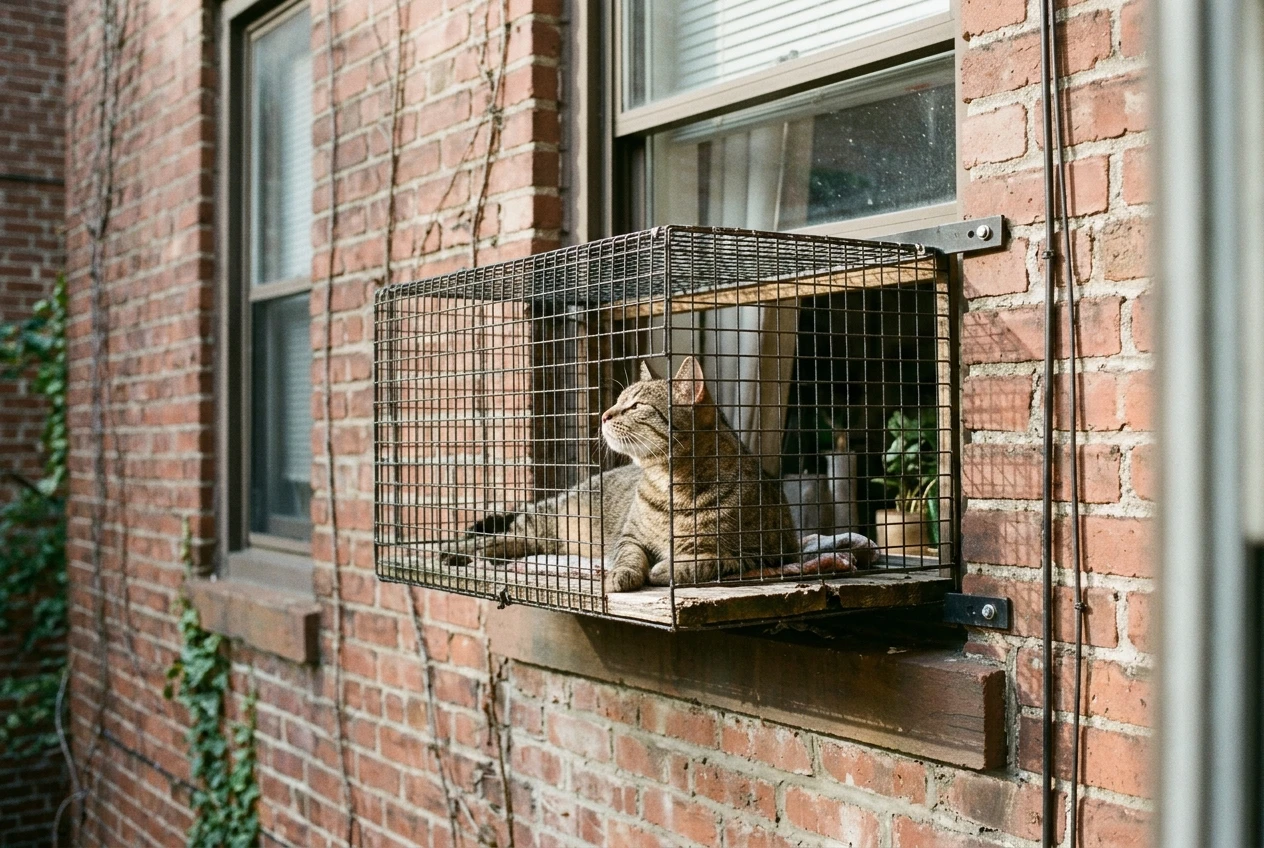
Window box
A window box is a small enclosure fixed to a window frame or outside wall, with the window itself as the cat’s entrance. It suits flats, rented homes and anyone testing whether their cat is interested at all. It offers a sit-and-sniff experience but little room to move, so expect your cat to lounge there rather than explore.
Check that the window can be opened and left open without letting the cat reach any unprotected gap. Check also that the box is bolted to something that can bear weight, because a cat jumping in lands with more force than you might expect. If you rent, ask your landlord before drilling anything into the building.
Balcony
A balcony is already a defined space, which makes it a good candidate for enclosing. Cats can jump onto railings and climb, so the whole open side and the top both need cat-proof mesh or netting, fixed firmly to the structure with no sagging sections. Cat-proofing a balcony is more than adding a top rail. Look at every gap between the floor and the rails, and at the corners where your barrier meets the building wall.
On a high balcony, wind exposure and falling risk both go up, so the structure needs to be sturdier. Building rules, shared-wall rules and landlord permission commonly apply, so check before you spend anything.
Patio
A patio next to your house wall lets you build a lean-to enclosure that attaches to the building, with the back door or a cat flap as the access point. This is often the easiest way to get a large catio with a simple, secure connection to the house. The roof can be solid, mesh or partly clear to let light in.
Think about sun and shade. A south-facing patio may be pleasant in October and punishing in July. Think also about which way the rain blows, and what the cat will see from inside: a view of a neighbour’s dog running along the fence may thrill some cats and frighten others.
Garden enclosure
A freestanding garden catio gives the most room and the most flexibility, and it can be connected to the house by a tunnel. It also needs the most thought. It needs a roof, because cats climb. It needs a floor or ground barrier, because cats dig and because other animals may dig in. It needs a secure, foundation-level fixing so wind cannot lift or shift it.
Check local planning rules and any restrictions if you rent or live in a managed community, because larger structures sometimes need permission.
Choose the access point before you finalise the design
Your cat needs an entrance that is easy and predictable. The best access points are ones your cat already uses and understands, such as a window your cat sits at or a door the cat already waits beside. A cat flap into the catio lets your cat decide when to go out, but it also means the enclosure must be secure at all hours, and a flap is another potential weak point.
For humans, a double-door entry (a small vestibule with two doors, only one of which is open at a time) removes the risk of the cat bolting past you while you carry in water or clean. If a vestibule is not possible, make a habit of confirming where the cat is before opening the outer door.
Safety first: mesh, gaps, doors and the escape points people miss
Most of the safety work happens at the joins. A mesh panel can be perfectly strong while the gap beside it is large enough for a cat to slip through. Cats can fit through surprisingly small openings, so assume that if a cat’s head fits through a gap, the cat may be able to follow.

Mesh and materials
Use heavy-gauge, welded wire mesh or purpose-made cat-proof netting designed for outdoor use, with a coating that resists rust. Avoid thin, flexible chicken wire: a determined cat or a wild animal can bend it, and cut edges can injure paws and noses. Check that any mesh edges are folded, capped or covered so nothing sharp faces inward.
Fix mesh to the frame with screws, staples set firmly into solid timber, or manufacturer-supplied clips. Cable ties alone are a temporary fix, because they can slip, snap in sunlight and come loose with time.
Escape points people miss
These are the places that most often get overlooked when people check for escape routes:
- The join between the catio and the house wall, especially around pipes, vents, window frames and uneven brickwork.
- The roof edge, where panels meet the wall or each other.
- Corners, where two mesh panels meet at an angle and a small gap can appear.
- The base, where the structure meets soil or paving, and where a digging cat can open a gap.
- Hinges and latches, where doors don’t sit flush when closed.
- Overhanging branches, fences or sheds that give a cat a way to climb onto the roof, or give other animals a way in.
- Cat flaps left unlocked or loosely fitted.
- Human error, such as a door left ajar after cleaning.
Doors and latches
Use self-closing hinges where you can, plus a latch that needs a thumb or a twist, not a simple lift. Some cats learn to work simple latches by watching, so test any latch you choose with a plan to improve it if needed. Keep the door fully closed whenever the cat is inside, even when you are standing right there.
Inspection routine
Do a full check before the first use and then a short one on a regular schedule. Walk around the outside and the inside, push on each panel, tug on each fixing, check the base and look at the roof. After storms or strong winds, check again. Wood swells, metal rusts and fixings loosen, so a catio that was secure in spring may not be by winter.
Identification
Even with a secure catio, make sure your cat has a microchip with current contact details. If your cat wears a collar, choose a breakaway design so it cannot become caught on mesh or branches. Your vet can also advise on parasite prevention and vaccinations that suit a cat with outdoor air exposure, even in an enclosed space.
Plants, surfaces and hazards to check before your cat goes out
Cats chew, lick, rub and nibble, and outdoors there are more things to nibble. Go through the whole catio, inside and just outside the mesh, before your cat ever sets foot in it.
Plants
Some common garden and decorative plants are poisonous to cats. Lilies are among the best known: all parts of true lilies can be very dangerous for cats, so keep them out of the catio and out of reach of anything the cat can touch through the mesh. Other plants that commonly appear on cat toxicity lists include sago palm, oleander, azalea, foxglove and tulip bulbs. Do not rely on memory or on this short list. Check every plant you grow nearby against a trusted, current list from a veterinary or animal welfare organisation, and ask your vet if you are unsure.
Plants growing outside the mesh matter too, since a cat can reach through a gap to nibble. Keep a clear margin between the catio wall and anything toxic.
For safe greenery, cat grass and catnip are popular choices. The article on the benefits of indoor grass for cats explains why grass appeals to cats, and the same logic applies in a catio planter. Not every cat responds to catnip, so treat it as something to try, not as a guarantee.
Chemicals and garden products
Check for fertiliser, slug pellets, weed killer, rodent bait, antifreeze and pest products anywhere near the catio. Some of these are highly toxic to cats, and even small amounts matter. If you use them in the garden, keep them well away from the structure and store them securely. The same cautious mindset used for household hazards for cats applies outdoors.
Surfaces
Look at what your cat will walk and lie on. Metal, dark paving and glass can get very hot in direct sun and cold in frost. Treated timber, paint and wood preservatives should be certified safe for animals and fully cured before use, so ask the manufacturer or choose products labelled pet-safe. Rough concrete can wear paws, and slippery decking can be treacherous when wet.
Provide a mix of surfaces: some warm and soft, some cool and solid, and at least one shaded area at all times.
Water and shelter
Always provide fresh water in a heavy bowl that will not tip. Make sure there is shelter from rain and wind, and shade from sun. Cats tend to avoid being exposed in all directions, so a catio with no covered spot can feel threatening however big it is.
Give your cat something to do: heights, hiding places, perches and scent
A bare enclosure is a box. A catio your cat wants to use gives it things to climb, hide in, watch from and sniff. Think about the behaviours your cat already shows indoors and offer outdoor versions of them.

Heights
Cats feel more secure when they can look down on their surroundings. Fit shelves, sturdy branches or stepped platforms at different heights, and make sure each is fixed securely and sized for the cat’s whole body. Provide more than one route up and down, so the cat never feels cornered by another animal or by you. Keep high perches away from the mesh roof edge unless the roof is fully secure and gap-free.
Hiding places
A covered box, a hollow log, a cat house or a thick planter with safe greenery gives the cat somewhere to retreat. A cat that can hide will often venture further. Place at least one hiding spot near the entrance, because a nervous cat will use it on the first visits, and another further in once the cat gains confidence.
Perches and sun spots
Cats love to watch. A perch with a view of the garden, a bird feeder placed outside the enclosure at a distance, or a window-height shelf can keep a cat occupied for hours. Watching birds can be intense, though. Some cats chatter, pace or become frustrated. If yours seems wound up rather than content, move the feeder further away or reduce the view.
Scratching and surfaces
Outdoors, cats still want to scratch. Give them a sturdy post, a log or a rough timber section anchored so it cannot topple. If your cat is already choosy about scratching at home, the guide on getting a cat to use a scratching post covers the preferences worth copying outdoors, such as height, stability and texture.
Scent
Scent is how cats decide whether a space is safe. Place a blanket or cushion your cat already sleeps on inside the catio, so it smells familiar from the first visit. Rub a clean cloth on your cat’s cheeks and wipe it on a few surfaces. Add a few safe plants, such as cat grass or catnip, for variety.
Introduce the catio slowly: a first-week routine that builds confidence
A cat that is pushed into a new space will often associate it with fear. A cat that is allowed to approach at its own pace usually accepts it. The plan below is a suggested sequence, not a fixed timetable. If your cat needs more time at one stage, stay at that stage.
Several skills help here. A cat that is comfortable in a carrier can be carried to the catio and released calmly, and a cat that has worn a harness can be supervised on a lead in the first sessions. If your cat is not yet used to either, work on that before the first visit.
Day 1: Look, don’t enter. Open the access point with the catio empty of other stimulation, and let your cat look and sniff from the doorway. Stay nearby and say nothing dramatic. Do not lift, push or lure the cat in with force. If the cat steps in, let it explore for a few minutes and then let it leave.
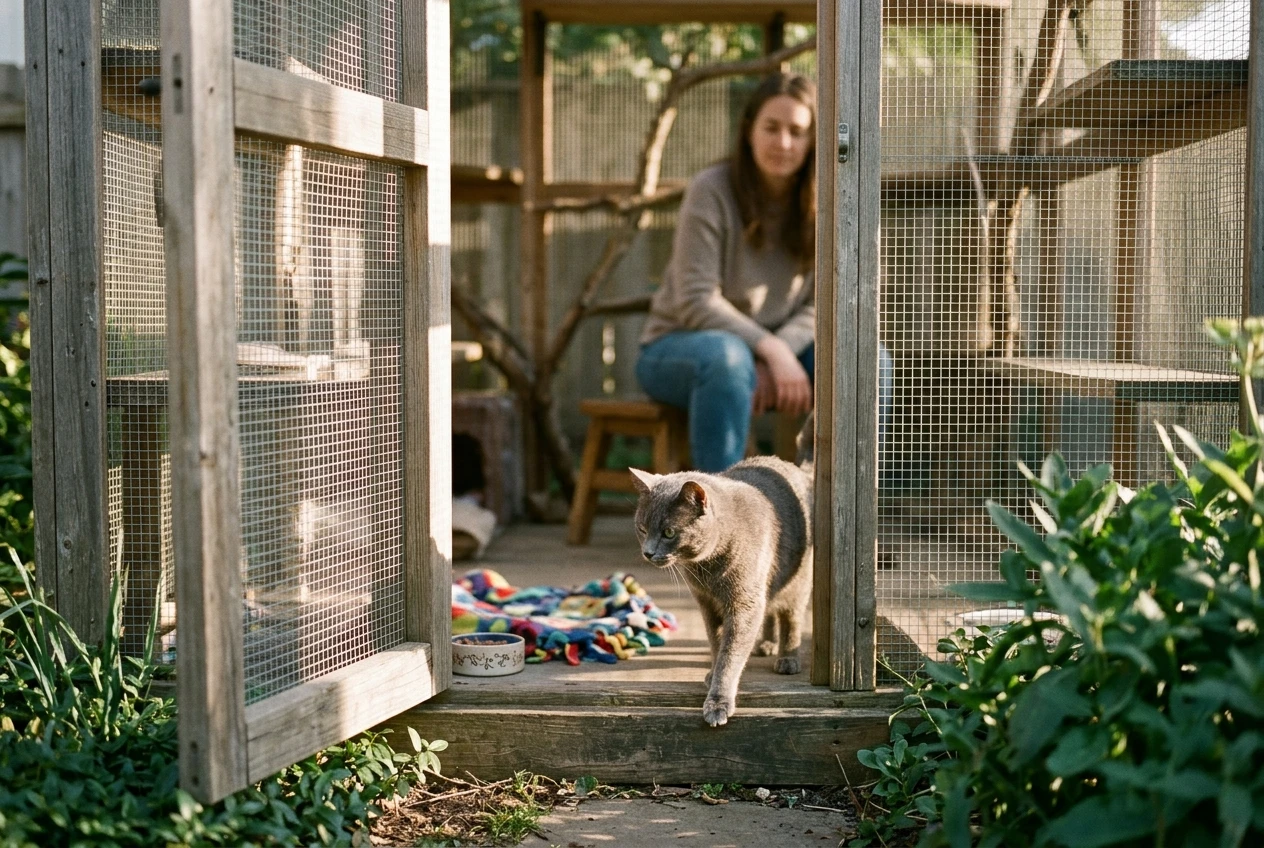
Days 2 and 3: Make it rewarding. Put the cat’s regular food bowl, a favourite treat or a toy just inside the entrance, then a little further in on later visits. Keep sessions short, ten minutes or so, and end them before the cat looks stressed. Sit quietly with your cat if it is relaxed with you there.
Days 4 and 5: Extend the time. Let the cat stay longer and explore the perches and hiding places. Stay present and in sight. Close the inner door briefly while you are there, then reopen it, so the cat learns that a closed door is normal and temporary.
Days 6 and 7: Link it to the daily routine. Choose a consistent time, perhaps before a meal or after play, and make the catio visit part of that rhythm. Cats thrive on predictability, and the importance of routines for cats explains why the same time and the same cues make new experiences easier to accept.
Reading your cat’s signals
Watch for flattened ears, a low crouch, a tucked tail, wide pupils, rapid breathing or darting back to the door. These signs mean the session has gone on long enough. Open the exit, let the cat leave and try a shorter session next time. Never force a cat to stay.
Loud noises, such as lawn mowers, barking dogs or fireworks, can undo progress quickly. Choose quiet times of day at first, and avoid introducing the catio during known noisy periods.
Supervision
Stay with your cat for the entire first week, and for longer if the cat is anxious or the catio is newly built. Leave a cat unattended only once you have seen it relax in the space many times and once you are certain the structure is secure and the weather is safe.
Keeping it interesting: rotating enrichment and seasonal changes
Cats lose interest in anything that never changes. A catio that was exciting in week one can become boring by month two. Small, regular changes keep your cat curious.
Rotate what is inside
Swap toys, boxes, scratching surfaces and plants every week or two. Move a perch to a new position, add a cardboard box or a paper bag for exploring, or hang a feather toy from the roof. Introduce one new thing at a time so the cat can investigate without being overwhelmed.
Keep notes, even informal ones, on what your cat uses. If a shelf has never been touched after several weeks, move it. If a sunny corner is a favourite, add another soft surface there.
Change the scents and views
Offer a new safe plant, a bundle of dried leaves from a cat-safe tree or a fresh patch of cat grass. Move a bird feeder to a different spot outside, or change the direction a perch faces. These small changes keep the senses engaged without altering the layout so much that the cat feels unsettled.
Plan for the seasons
In summer, shade and water matter most. Add shade cloth or a solid roof panel, keep water in a shaded spot and check surfaces for heat before your cat steps out. Avoid the hottest part of the day.
In autumn and winter, rain and wind can make an open catio unpleasant. Clear roof panels and windbreaks help, as does a covered, draught-free shelter with a blanket. Cats differ in how well they tolerate cold, so shorten sessions when it is chilly and bring your cat in if it seems uncomfortable. If you use any heated bed, choose one designed for outdoor pet use and follow its safety instructions.
Check the structure after storms, remove wet leaves from surfaces so they don’t become slippery, and look for damp or rot in timber.
Keep the daily habit
Regular timing turns a catio from a novelty into a habit. If your cat has settled into a morning visit, keep it there. If you change your own schedule, try to keep the cat’s catio time steady. A habit that has formed around a daily routine is more likely to last than one that depends on the owner’s spare time.
Plan your own catio
Look at the spaces you already have: a window, a balcony or a patch of garden. Pick the one you can secure most easily, then sketch a first plan on paper. Mark the access point, the mesh and roof, the places for perches and hiding spots, and the shaded areas. Even a rough drawing will show you the gaps and decisions you haven’t made yet.
While you plan, get your cat ready for the first visit. A cat that already travels calmly can be carried to the catio without stress, so start with how to carrier train a cat. If you want to supervise early sessions on a harness, how to train a cat to walk on a leash covers that groundwork.