
Hello, Cat Enthusiasts!
Cats don’t measure a home in square metres. They measure it in places to sit, watch, retreat and travel between, and a room with a lot of floor can still feel small if everything is at one level. A cat highway adds usable territory without a larger flat: a connected route of shelves, perches, tree platforms and bridges that lets a cat cross a room without touching the ground.
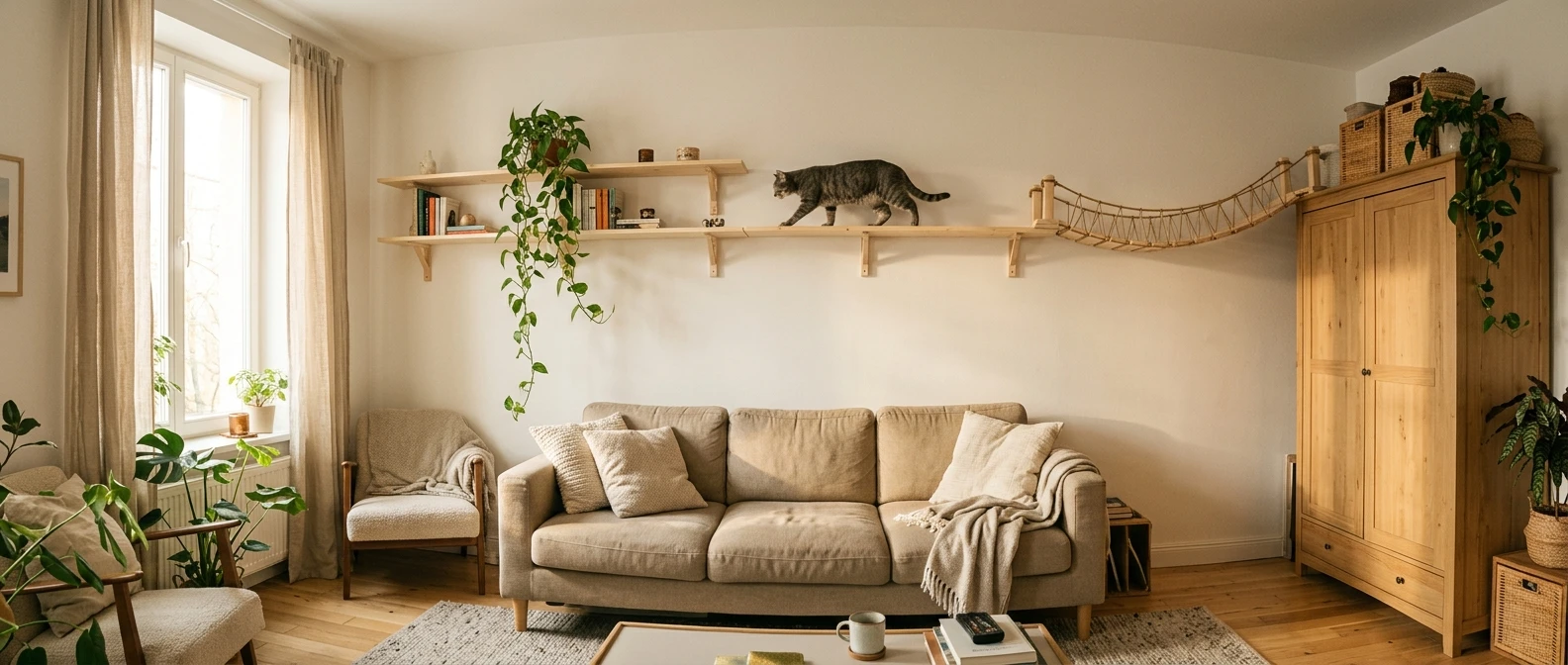
This guide covers how to build a cat highway in a small home or rental: how to plan it, what to build it from, how to fix it safely, and how to get a cat to use it. The planning matters most. A set of shelves put up because they looked good on a wall is far more likely to end up as expensive decoration than a route planned around how cats move.
Why height matters more than floor space to a cat
A cat uses height for three things. It gives a view of the room, so the cat can see what is happening without being in the middle of it. It gives a place to retreat where nothing can approach from above. And it lets cats share a room without sharing a patch of floor, because two cats at different levels can ignore each other more easily than two cats on one rug.
In a small flat the floor is mostly spoken for by a sofa, a bed, a table and a rack of shoes. The vertical space above those things is usually empty. A route along the tops of furniture, up the side of a wall and across a window frame turns that empty space into territory the cat can patrol.
A cat highway also serves several of the needs covered in Basic Indoor Cat Needs, including exercise, mental stimulation and a feeling of security. It supports them by giving the cat something to do every day, which a single cat tree in a corner often fails to do.
A highway differs from a collection of climbing furniture in one respect: the pieces connect. A cat that jumps onto a shelf, finds nowhere to go, and has to jump back down has used a perch. A cat that can step from the shelf to a bridge, to a tree, to a window ledge and back down by another way has used a route. Routes get used more often because every piece leads somewhere.
Map your room before you buy a single shelf
Before buying anything, spend an evening watching how the room already works. Cats make their own routes, and the best highways follow them.
Look at where your cat already goes up. Which piece of furniture do they leap onto first? Which windowsill do they favour? Where do they sit to watch the door? These spots are your anchor points, and a route that links them will feel familiar from the first day.
Then sketch the room. A rough plan on paper is enough. Mark:
- Windows, and which ones have a view of birds, trees or the street
- Doors, including any that stay open and any a cat might be shut behind
- Large furniture a cat can already stand on: wardrobes, bookcases, the top of a fridge
- Radiators, hobs, lamps and anything hot, breakable or unstable near a possible route
- Places where the cat sleeps, eats and uses the litter tray, so the route doesn’t pass through them
- The wall sections where you are allowed to drill, and where a pipe or cable might run
With the plan in front of you, trace a possible path at the level you intend to build. Start at a spot the cat can reach easily, such as the sofa arm or a low cabinet, and move up in steps. Mark each place where the cat would have to jump or step. Those are the points that decide whether the route works, and the next section explains how to judge them.
Also measure. Note the length of wall available, the ceiling height, and the gap between furniture and wall. Buying with measurements in hand avoids returning shelves that don’t fit the space you thought you had.
The rules of a good route: landing zones, two exits and no dead ends
Three rules cover most of what makes a highway usable. Check every part of your plan against them.
Landing zones
Every jump needs somewhere to land. A landing zone is a surface big enough for a cat to arrive on with all four paws, stop, and turn around if needed. A narrow plank that a cat can only cross in a straight line is not a landing zone. Cats are cautious about jumps they can’t judge, and a small or wobbly target will make a cat decline the route altogether.
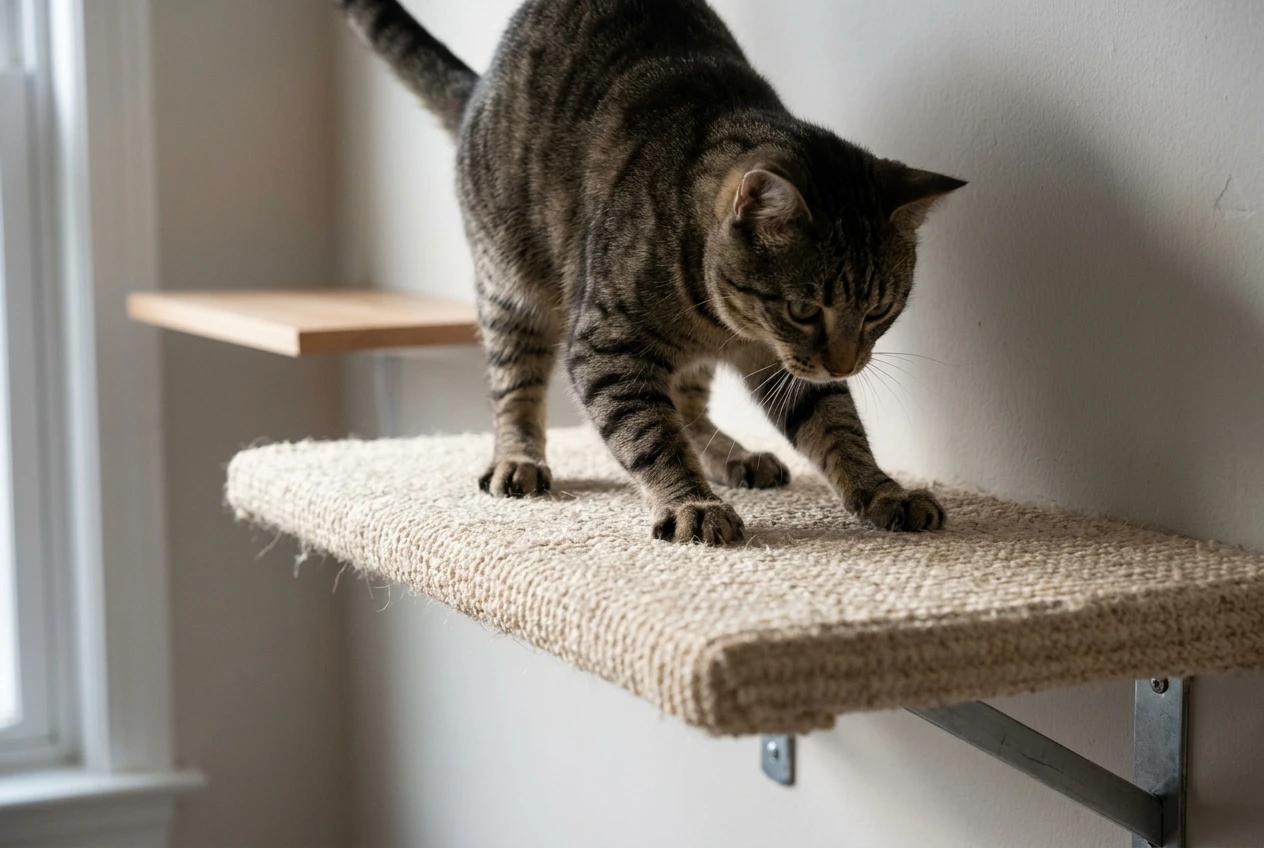
Make each landing surface wider than you think necessary, make it firm, and give it some grip. Carpet, sisal or a non-slip mat on the surface helps a cat’s claws hold. A smooth varnished shelf can send a cat sliding off the edge on arrival.
Keep the distances between levels comfortable, not impressive. A cat that is able to make a jump will not necessarily choose it every time, especially when jumping from one narrow shelf to another. Smaller steps between pieces mean the route gets used more often, and they are kinder to older joints.
Two exits
A good route gives a cat two ways to leave any point. The reason is practical: a cat sitting on a shelf with one way down can be blocked by another cat, a child, a vacuum cleaner or a startling noise, and a cat that feels trapped will stop using that perch. With two exits, the cat can always leave without squeezing past something it is wary of.
In practice this means looping the route where space allows. Rather than a single line of shelves along one wall, run a second connection back down at the far end, or link one level to a second route across a window or a tree. Even a small loop helps. In a multi-cat home it is the most important rule of all, because two cats meeting nose to nose on a one-way plank is how fights start.
No dead ends
A dead end is any point where a cat has to turn around and return the way it came. One can be fine as a deliberate resting place, such as a snug bed on top of a wardrobe, provided the cat is the only one using that part of the route and can leave easily. A dead end becomes a problem when it sits in the middle of a route that other cats or people pass through, or when the way back is awkward.
Walk your plan on paper with a finger. If your finger ever has to go backwards, ask whether that spot is a destination or a trap. Destinations are fine. Traps need a second link added.
Choosing what to build with: wall shelves, cat trees, window perches and bridges
Most highways use a mix of four kinds of piece. Each does a different job, so the right combination depends on your room.
Wall shelves do the work of connecting levels. They cost less floor space than anything else, since they take none, and they can be placed exactly where the route needs them. Buy shelves designed for cats, or sturdy shelves with a deep enough surface to land on comfortably, and add grip. Shelves made for books and ornaments are often too narrow and too slippery. Their brackets may also not suit a cat’s repeated jumping.
Cat trees work as the stable anchor of a route. A tree gives you levels, scratching surfaces and a base the cat can climb from the floor. In a small home, pick a tall and narrow design over a wide one, and place it where it connects to a shelf or the top of a cabinet. A tree that stands alone in a corner is a perch. A tree whose top platform lines up with the first shelf of the route is the start of a highway.
Window perches give a route a purpose. A cat will go a long way for a view, and a perch at a window that overlooks activity gives the whole route a destination. Choose a perch that is stable and wide enough to lie on, and check that the window itself is secure, with a catch or screen that cannot be pushed open by a leaning cat.
Bridges link pieces across gaps: from shelf to wardrobe, or from one wall to another. A bridge should be wider than a cat’s body, have a surface with grip, and ideally have a slight edge or rail so a cat that misjudges a step does not slide off. Fix both ends securely. A bridge that shifts underfoot teaches a cat to distrust the whole route.
Whatever you choose, keep the materials cat-friendly. Avoid anything with small parts a cat could chew off, strong chemical smells from new paint or varnish, and rough edges. Let new wood or finishes air out before the cat gets near them.
Plants near a route deserve a check as well. Our guide on how to keep a cat away from plants covers the problem, and some common houseplants are harmful to cats, so a highway that runs past a plant shelf needs a rethink.
Fixing things safely: weight, wall types and renter-friendly options
A cat highway is only as good as its fixings. A shelf that pulls out of a wall while a cat is on it can injure the cat and will make it avoid the route afterwards.
Weight
Check the load rating of every shelf, bracket and fixing, and remember that a cat jumping onto a shelf puts more force on it than the same cat sitting still. Choose fixings rated for well above your cat’s weight, and more so in a multi-cat home where two cats might be on one shelf. If a product has no stated load rating, treat that as a reason to look at another product.
Load-test every piece before the cat uses it. Once it is fixed, press down hard on it with your hands, then place a weight on it that is clearly heavier than your cat, such as a full bag of shopping or a filled water container, and leave it for a while. Watch for flexing, creaking, loosening screws or a shelf that tilts. Check again after a week, because fixings can work loose with use. Make this a regular check, perhaps monthly, rather than a one-time job.
Wall types
How you fix a shelf depends on what is behind the surface of the wall.
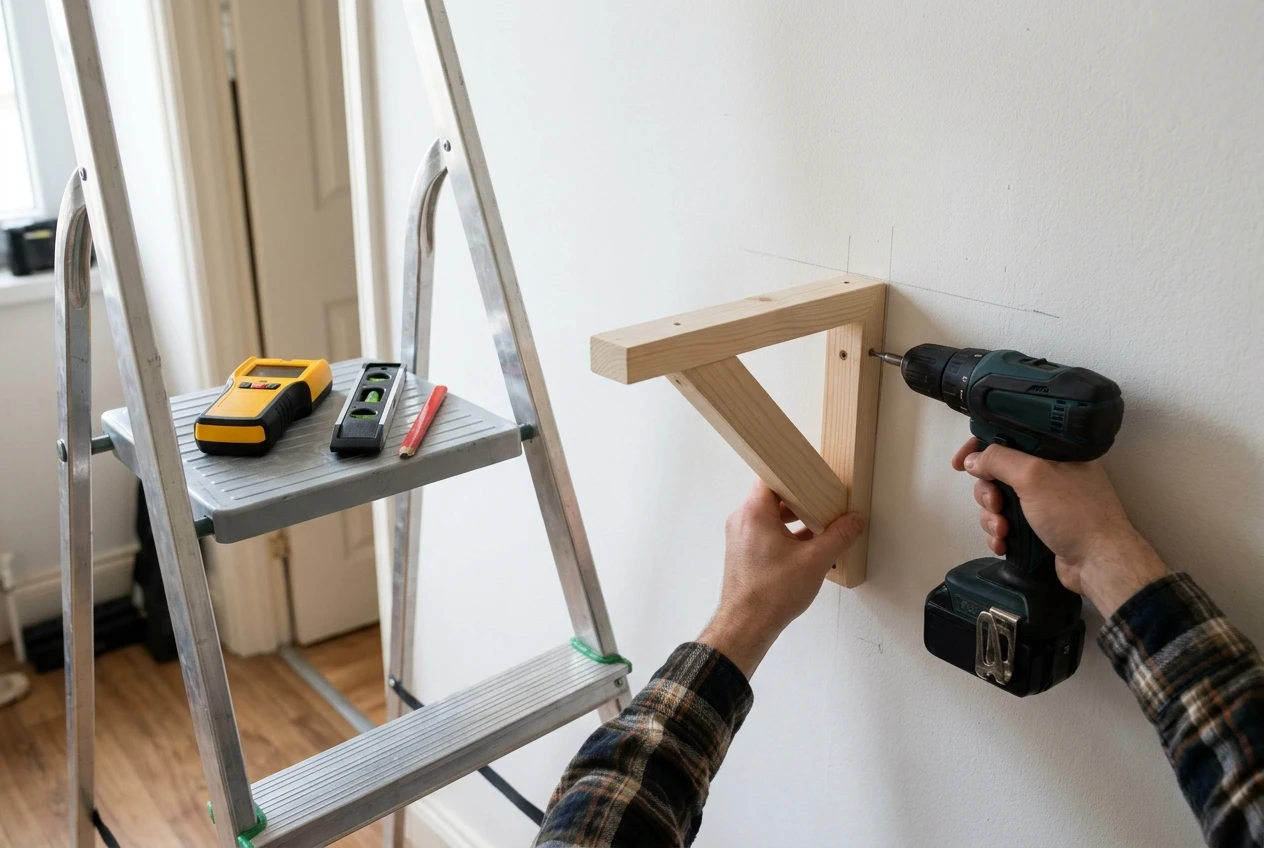
- Plasterboard or drywall is hollow, so a screw into the board alone holds very little. Locate the studs behind the board and fix brackets into those where you can. Where you cannot, use heavy-duty hollow wall fixings rated for the load, and read the manufacturer’s instructions.
- Brick, block or concrete needs a drill suited to masonry and wall plugs of the right size. These walls hold well once the fixings are correct.
- Older plaster and lath walls can be fragile. Finding solid timber behind them matters even more, and it may be worth asking someone experienced before drilling.
If you are unsure what your walls are made of, or whether a pipe or cable runs behind the spot you’ve chosen, find out before you drill. A cheap detector for studs and cables is worth having.
Renter-friendly options
Check your tenancy agreement before drilling into any wall, and ask your landlord if the agreement is unclear. Many landlords will agree to a few fixings, especially for something that is clearly useful and can be repaired, but permission should be in writing.
If drilling is not allowed, you have several choices:
- Freestanding cat trees that reach tall levels without touching the wall. Use an anti-tip strap or a heavy base so they cannot topple when a cat launches off them.
- Furniture-top routes, where shelves or platforms sit on top of wardrobes and bookcases that are already stable. Check that the furniture itself is heavy enough not to tip, and secure it if it is not.
- Floor-to-ceiling tension poles, which hold by pressure against floor and ceiling. They only suit solid, flat ceilings, and you should follow the manufacturer’s guidance about weight and about ceiling types.
- Window-mounted perches that attach with suction or clamp to the frame, provided they carry a rating for your cat’s weight.
In each case, test the piece harder than you expect your cat to. A renter-friendly fixing that fails is no use to anyone.
Safety checks for kittens, seniors and cats with mobility limits
Not every cat can use the same route. A highway for a young, agile adult can be unsafe for a kitten or an older cat, and the same room may need two versions of the route.
Kittens are enthusiastic and poor at judging distances. They also fit through gaps an adult cat cannot, so check that no space along the route is wide enough for a kitten to fall through or get stuck in. Keep the route low until the kitten is steady, with short steps between levels, and make sure every surface has grip. Kittens often explore a route when you are not looking, so a kitten that is not yet reliable on it needs supervision or a closed door until it is.
Senior cats may have stiff joints, weaker muscles or poorer eyesight, and a jump that was easy two years ago may now be painful. Watch whether your cat hesitates before jumping, lands heavily, or has stopped using high places it once loved. These are signs to lower the route, widen the steps and add ramps, and to mention to your vet. For some cats, the best highway sits at the level of a sofa arm and a low cabinet, with steps that are close together.
Cats with mobility limits, whether from arthritis, an old injury, a missing limb or neurological problems, need a route designed around what they can do. Ask your vet what movements are safe. In general:
- Use ramps with a gentle slope and a textured surface instead of jumps
- Make platforms wide enough to turn around on without risk of slipping off
- Keep heights modest, so a fall does little harm
- Provide a low alternative so the cat never has to use the high route
- Keep the layout the same once you’ve built it, which matters especially for cats with poor eyesight
For every cat, check the whole route for hazards. Blind cords, open windows without screens, fragile ornaments along a shelf, hot lamps and anything a cat could knock down are all worth removing. Our list of household hazards for cats is a useful checklist to run through the route once it is built.
How to introduce the route so your cat actually uses it
A finished highway is not a finished job. Cats distrust new objects, and a route that appears overnight may be ignored for days. Introduce it in stages.
Build in stages. Add one piece at a time, starting with the one closest to the floor. Let the cat get used to it before adding the next. A cat that has already accepted the first level will accept the second more easily than one facing a full route at once.
Let the cat inspect first. Leave the new piece in the room and let your cat sniff, rub and walk around it. Do not pick the cat up and place it on a shelf. Being put somewhere teaches a cat that the place is something that happens to it.
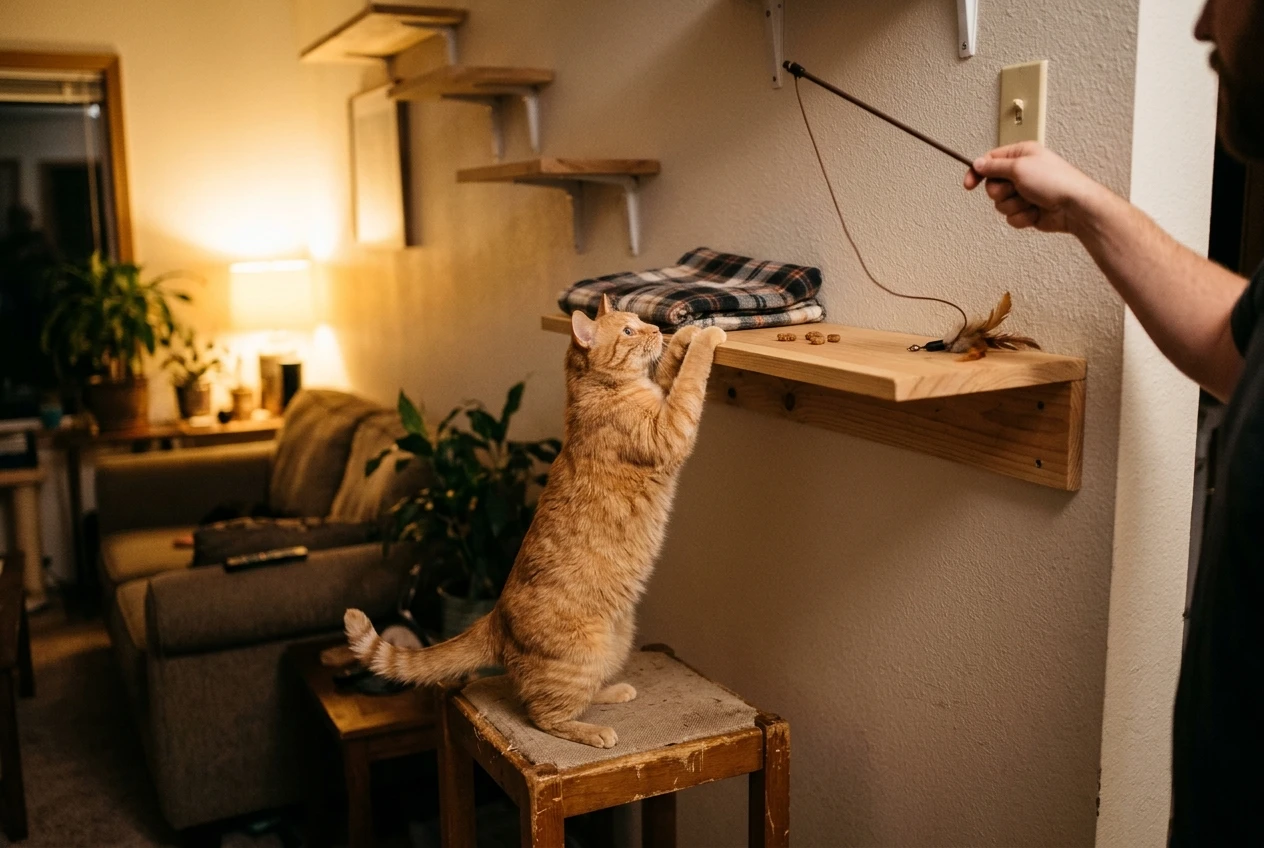
Make each piece worth visiting. Place a treat, a favourite toy or a blanket that smells of the cat on the first level. Move the reward a step further along as the cat gets confident. Cats learn from what pays off, and how cats learn explains why rewarding the behaviour you want works better than coaxing or pushing.
Use play. A wand toy dragged slowly along a shelf or up a bridge gets a cat moving along the route without any pressure. Keep sessions short and end while the cat is still interested.
Put something at the end. A route needs a destination. A bed in a warm spot, a window with a view or a feeding spot at the top of the route gives the cat a reason to travel it every day.
Keep it calm. Never chase a cat onto the route, and avoid loud noises or sudden movements while the cat is up there. A cat that has a bad experience on a shelf will stay off it. If the cat jumps down in a hurry, stop, take the next step back, and try again later.
Be patient. Some cats take to a route in an afternoon, and others need a few weeks. Both are normal.
Troubleshooting a highway your cat ignores or fights over
Even a well-planned route can run into problems. Work out which one you have before changing anything.
The cat ignores the route
Common causes, and what to try:
- The first step is too high or too far. Add a lower step, such as a stool or a small box, between the floor and the first level.
- The surface is slippery. Add a non-slip covering. A cat that slips once may refuse to try again.
- A piece wobbles or creaks. Fix it firmly, or replace it. Cats notice movement that people miss.
- The route doesn’t lead anywhere interesting. Add a window view, a bed or a feeding spot at the top.
- It sits away from where the cat spends time. Move the start of the route towards the cat’s favourite resting place.
- The cat has been startled on it. Go back to rewards and play at a low level, and rebuild confidence slowly.
- The cat is older or in pain. If a cat that used to climb has stopped, a vet visit is the sensible next step, and our post on cat behaviours to worry about covers other changes worth watching.
Cats fight over the route
In a home with more than one cat, a highway can become disputed territory, especially if there is one good perch or a narrow section where cats must pass each other.
- Add exits. The most common fix is a second way off every platform, so no cat can be cornered.
- Add duplicates. Provide more than one window perch, more than one bed and more than one high resting place, so the best spots are not worth fighting for.
- Widen narrow sections. Two cats should be able to pass each other without touching, or at least not meet head on.
- Watch the timing. Notice whether trouble happens at certain times, such as before meals, and adjust where food and attention are given.
- Look at body language. Staring, hissing, blocking and ambushing from above are signs that a cat is not comfortable on the route, even if no fight happens.
If the conflict is serious, or if one cat is avoiding the whole room, take the route out of use for a while and speak to a vet or a qualified cat behaviourist. A route that causes constant stress is doing the opposite of its job.
Once a highway is working, keep an eye on it. Check the fixings regularly, wipe the surfaces, and move or add pieces if the cat’s habits change. A route that suits your cat today may need adjusting when a kitten grows up or an older cat slows down.
Thank You For Reading!